 Anas Alam Faizli Magna Est Veritas Prae Velabit – The Truth is Mighty and will always Prevail!
Related Articles

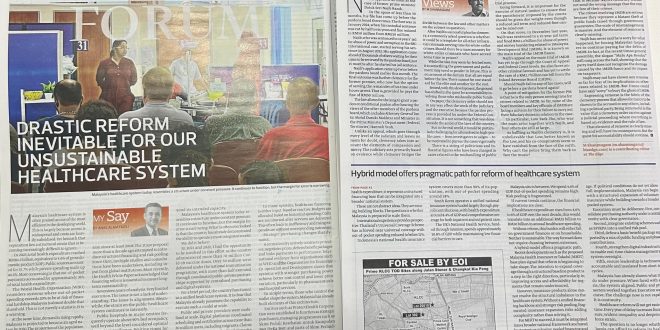
Malaysia’s healthcare system is often praised as one of the most efficient in the developing world. This is largely because access is widespread and costs are heavily subsidised. Yet beneath that reputation lies a structural strain that is becoming increasingly difficult to ignore.
In 2023, Malaysia’s total health expenditure reached RM84.2 billion, equivalent to 4.6 percent of GDP. Public sources accounted for 55.7 percent while private spending made up 44.3 percent. Most concerning is that out of pocket payments accounted for approximately 36 percent of total health expenditure.
The World Health Organization considers systems where out of pocket spending exceeds 20 percent to be at risk of financial hardship. Malaysia is almost double that threshold.
This is not merely a statistic. It is a warning.
At the same time, demand is rising rapidly. Malaysia is projected to become an aged nation by 2030. The proportion of the population aged 65 and above is expected to rise from around 8 percent today to more than 15 percent by 2040.
Non communicable diseases already account for more than 70 percent of deaths. Adult diabetes prevalence is close to 18 percent. Hypertension affects roughly 30 percent of adults. More than half of Malaysians are overweight or obese.
These are not short term pressures. They are long term cost drivers that will compound over decades.
Yet Malaysia’s healthcare financing model has remained largely unchanged.
Malaysia has been discussing financing reform, including National Health Insurance, since at least 2008. The 1Care proposal more than a decade ago attempted to introduce structured financing and risk pooling. Since then, multiple studies and consultations have been undertaken, including input from global institutions. Most recently, the Health White Paper acknowledged that financing reform is essential to ensure long term sustainability.
Seventeen years of analysis.
Very limited execution.
The issue is not a lack of understanding. The issue is alignment.
Meanwhile, the strain on the public healthcare system continues to intensify.
Public hospitals in major centres frequently operate above 90 percent bed occupancy, well beyond the level considered optimal for system resilience. Waiting times for specialist care can stretch for months. In some cases, elective procedures take significantly longer. Waiting period for bypass can be more than 13 months.
The contract doctor issue has affected more than twenty thousand medical officers over recent years, contributing to uncertainty in career progression and morale. Migration to private practice and neighbouring countries continues.
This is not a failure of our healthcare professionals.
It is a system operating beyond its intended capacity.
Malaysia’s healthcare system today resembles a structure under constant pressure. It continues to function, but the margin for error is narrowing.
What is often overlooked is that Malaysia has already demonstrated the ability to operate a more integrated model.
We did it before!
Between 2021 and 2022, I had the opportunity to be involved in this effort as the country administered more than 70 million COVID 19 vaccine doses. Over 50 million were delivered under the national immunisation programme, with more than half executed through coordinated public private partnerships supported by centralised purchasing and digital systems.
For a brief period, Malaysia functioned as a unified healthcare system. It is clear that Malaysia already possesses the capability to execute such a model at scale.
Public and private providers were mobilised at scale. Digital platforms coordinated scheduling and certification across more than 30 million users, including migrants. Claims and payments were standardised. Capacity was deployed where it was needed most.
This was not incremental improvement.
It was system level execution.
It proved something fundamental.
Fragmentation is not inevitable. It is a choice.
The tragedy is not that Malaysia lacks capability. The tragedy is that we have not institutionalised what we have already demonstrated.
At the heart of this discussion is a concept that remains underutilised.
Strategic purchasing.
In many systems, healthcare financing is either input based or reactive. Budgets are allocated based on historical spending. Costs are reimbursed after services are delivered. This often leads to inefficiency and rising expenditure without corresponding outcomes.
Strategic purchasing changes that dynamic.
A central entity actively contracts providers, negotiates prices, defines benefit packages and links payments to performance. International evidence from organisations such as the World Health Organization (WHO) and the Organisation for Economic Co-operation and Development (OECD) shows that systems with stronger purchasing power achieve better cost control and lower price variation, particularly in pharmaceuticals and hospital services.
In simple terms, those who control the wallet shape the system.
Malaysia has already built elements of this architecture.
Entities such as ProtectHealth Corporation were established to function as strategic purchasers, managing programmes such as PeKa B40 and parts of SPIKPA. These initiatives introduced targeted coverage, risk pooling and centralised purchasing mechanisms.
SPIKPA, the mandatory insurance scheme for foreign workers, covers an estimated two to three million individuals. With premiums of approximately RM120 per worker annually, it generates a pool of around RM300 million each year. While modest in the context of total health expenditure, it represents a structured financing base that can be integrated into a broader national system.
These are not abstract ideas.
They are existing building blocks.
The question is whether Malaysia is prepared to scale them.
International experience provides perspective.
Thailand’s Universal Coverage Scheme has achieved near universal coverage with out of pocket spending reduced to below 12 percent.
Indonesia’s national health insurance system covers more than 90 percent of its population, with out of pocket spending around 28 percent.
South Korea operates a unified national insurance system funded largely through payroll contributions, with health expenditure around 8.4 percent of GDP and comprehensive coverage for both inpatient and outpatient care.
The United Kingdom’s National Health Service, funded through taxation, spends approximately 10.8 percent of GDP while maintaining low financial barriers to care.
Malaysia sits in between.
We spend 4.6 percent of GDP. Out of pocket spending remains high. Risk pooling is fragmented.
If current trends continue, the financial implications are clear.
If healthcare expenditure rises from 4.6 percent to 6 percent of GDP over the next decade, this would translate into an additional RM25 billion to RM30 billion in annual healthcare spending.
Without reform, this burden will either fall on government finances or on households.
Neither is sustainable.
The way forward does not require choosing between extremes.
A hybrid model offers a pragmatic path.
Recent developments such as the proposed Malaysia Health Insurance or Takaful base plan signal that reform is beginning to take shape. The intent to expand coverage through a structured baseline product is a step in the right direction, particularly in improving access and affordability for segments that remain underinsured.
However, insurance products alone cannot resolve the structural imbalance in Malaysia’s healthcare system. Without a unified financing backbone and stronger risk pooling, fragmented insurance expansion risks adding complexity rather than solving it.
For MHIT to succeed, it must be integrated into a broader national framework anchored by strategic purchasing, pooled financing, and clear governance. Otherwise, it risks becoming another layer in an already fragmented system. MHIT is a step forward but it is not yet a system. Insurance expansion without purchasing reform risks driving utilisation without controlling cost.
A National Health Insurance layer can provide baseline protection and pooled financing, complemented by voluntary insurance for those seeking additional coverage. If political conditions do not yet allow full implementation, Malaysia can begin with a structured expansion of voluntary insurance while building toward a broader pooled system.
Execution must be deliberate.
First, consolidate purchasing authority under a central entity with clear governance.
Second, integrate existing schemes such as SPIKPA into a unified risk pool.
Third, define a basic benefit package supported by a mix of public funding and phased contributions.
Fourth, strengthen digital infrastructure to enable real time claims management and system oversight.
Fifth, ensure leadership is technocratic, accountable and insulated from short term cycles.
Malaysia has already shown what it can do under pressure.
When faced with crisis, the system aligned. Public and private sectors worked together. Execution was decisive. The challenge now is not capability. It is continuity.
Healthcare reform will not get easier with time. Every year of delay increases fiscal pressure, widens inequality and deepens workforce strain.
The question is no longer whether Malaysia can afford to reform its healthcare financing system. The question is whether Malaysia can afford not to.
Seventeen years of discussion is enough. We already know what needs to be done. The only question that remains is whether we will act before the system forces us to.


