Anas Alam Faizli Magna Est Veritas Prae Velabit – The Truth is Mighty and will always Prevail!
Related Articles


By Anas Alam Faizli
Malaysia is not short of plans. Nor is it short of capital.
Malaysia’s major institutional funds collectively manage close to RM2 trillion, a figure broadly comparable to the size of the economy itself. Yet national investment in research and development remains at approximately 1% of GDP, far below leading economies such as South Korea, which consistently invests between 4% to 5%.
This gap is not one of resources. It is one of alignment.
Over the past decade, Malaysia has introduced multiple national strategies across industry, healthcare and energy transition, each designed to position the country for its next phase of growth. Its corporate sector remains regionally competitive, with the electrical and electronics sector contributing over 40% of exports, exceeding RM570 billion annually. The digital economy contributes more than 23% of GDP.
On paper, the ingredients are in place.
Yet outcomes often fall short of potential.
Industrial upgrading progresses, but not at the pace required. Innovation exists, but rarely scales into global leadership. Strategic sectors emerge, but seldom with the coherence or speed seen in more competitive economies.
This raises a question that is seldom asked directly.
Who actually governs Malaysia, not in theory, but in execution?
Having worked across healthcare, pharmaceuticals, energy and regulated industries, I have often observed that outcomes are rarely determined by any single institution, but by how well they move together.
Malaysia operates less like a single coordinated system and more like a federation of capable actors, each with its own mandate, authority and priorities. Ministries design policies. Government-linked companies execute strategies. Institutional funds allocate capital. Regulators shape markets. State governments control land and approvals.
Each performs its role.
But they do not always move in the same direction.
This misalignment is not abstract. It is visible in sectors that matter.
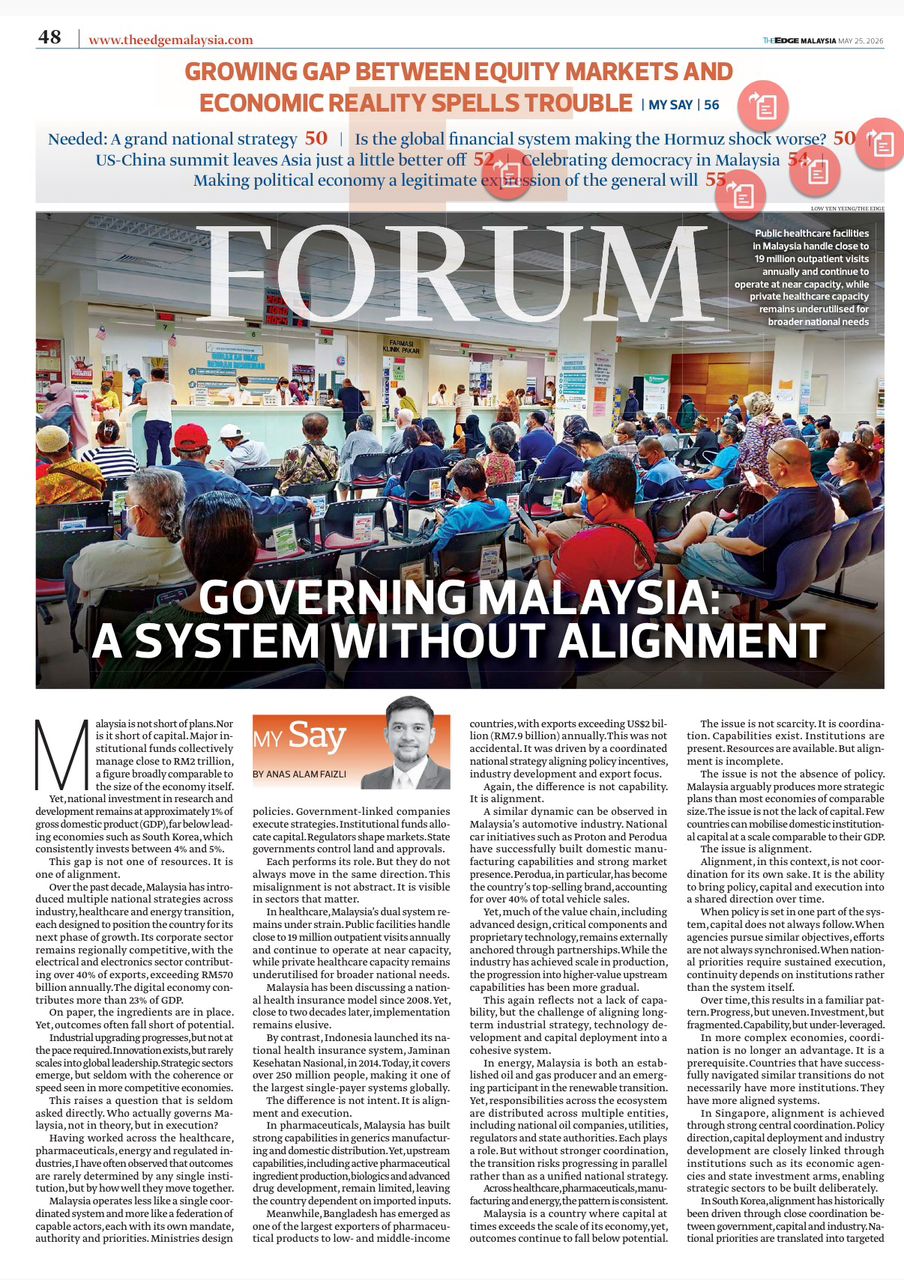
In healthcare, Malaysia’s dual system remains under strain. Public facilities handle close to 19 million outpatient visits annually and continue to operate at near capacity, while private healthcare capacity remains underutilised for broader national needs.
Malaysia has been discussing a national health insurance model since as early as 2008. Yet close to two decades later, implementation remains elusive.
By contrast, Indonesia launched its national health insurance system, Jaminan Kesehatan Nasional, in 2014. Today, it covers over 250 million people, making it one of the largest single-payer systems globally.
The difference is not intent.
It is alignment and execution.
In pharmaceuticals, Malaysia has built strong capabilities in generics manufacturing and domestic distribution. Yet upstream capabilities, including active pharmaceutical ingredient production, biologics and advanced drug development, remain limited, leaving the country dependent on imported inputs.
Meanwhile, Bangladesh has emerged as one of the largest exporters of pharmaceutical products to low- and middle-income countries, with exports exceeding USD 2 billion annually. This was not accidental. It was driven by a coordinated national strategy aligning policy incentives, industry development and export focus.
Again, the difference is not capability.
It is alignment.
A similar dynamic can be observed in Malaysia’s automotive industry. National car initiatives such as Proton and Perodua have successfully built domestic manufacturing capabilities and strong market presence. Perodua, in particular, has become the country’s top-selling brand, accounting for over 40% of total vehicle sales.
Yet much of the value chain, including advanced design, critical components and proprietary technology, remains externally anchored through partnerships. While the industry has achieved scale in production, the progression into higher-value upstream capabilities has been more gradual.
This again reflects not a lack of capability, but the challenge of aligning long-term industrial strategy, technology development and capital deployment into a cohesive system.
In energy, Malaysia is both an established oil and gas producer and an emerging participant in the renewable transition. Yet responsibilities across the ecosystem are distributed across multiple entities, including national oil companies, utilities, regulators and state authorities.
Each plays a role. But without stronger coordination, the transition risks progressing in parallel rather than as a unified national strategy.
Across healthcare, pharmaceuticals, manufacturing and energy, the pattern is consistent.
Malaysia is a country where capital at times exceeds the scale of its economy, yet outcomes continue to fall below potential.
The issue is not scarcity.
It is coordination.
Capabilities exist. Institutions are present. Resources are available.
But alignment is incomplete.
The issue is not the absence of policy. Malaysia arguably produces more strategic plans than most economies of comparable size. The issue is not the lack of capital. Few countries can mobilise domestic institutional capital at a scale comparable to their GDP.
The issue is alignment.
Alignment, in this context, is not coordination for its own sake. It is the ability to bring policy, capital and execution into a shared direction over time.
When policy is set in one part of the system, capital does not always follow. When agencies pursue similar objectives, efforts are not always synchronised. When national priorities require sustained execution, continuity depends on institutions rather than the system itself.
Over time, this results in a familiar pattern.
Progress, but uneven.
Investment, but fragmented.
Capability, but under-leveraged.
In more complex economies, coordination is no longer an advantage.
It is a prerequisite.
Countries that have successfully navigated similar transitions do not necessarily have more institutions. They have more aligned systems.
In Singapore, alignment is achieved through strong central coordination. Policy direction, capital deployment and industry development are closely linked through institutions such as its economic agencies and state investment arms, enabling strategic sectors to be built deliberately.
In South Korea, alignment has historically been driven through close coordination between government, capital and industry. National priorities are translated into targeted investments, supported by sustained R&D spending exceeding 4% of GDP, enabling the country to move decisively into high-value sectors such as semiconductors and advanced manufacturing.
Indonesia offers a different lesson by alignment through execution. Despite its scale and complexity, it aligned policy, financing and delivery to roll out national healthcare to over 250 million people, and more recently coordinated industrial policy and investment to position itself in the electric vehicle and battery value chain.
These countries differ in structure.
But they share one characteristic.
They align policy, capital and execution within a coherent system.
Malaysia, by contrast, has built strong components of a system, but has yet to fully align them.
This distinction is subtle, but critical.
It suggests that Malaysia’s next phase of development will depend less on creating new institutions, and more on strengthening the connections between existing ones.
What then might alignment look like in practice?
One starting point is capital.
Malaysia’s institutional funds manage close to RM2 trillion. If even 5% to 10% of this were deliberately aligned toward strategic sectors such as healthcare reform, upstream pharmaceuticals or energy transition, it would represent tens of billions of ringgit in patient capital.
At that scale, coordination becomes transformative.
The question is where such coordination resides.
It is unlikely to sit within any single ministry or institution. Alignment requires a vantage point that cuts across mandates, bringing together policy, capital and execution.
Malaysia has demonstrated this capability before. With clear targets, structured oversight and consistent leadership, complex national initiatives have been delivered successfully.
The challenge is not whether Malaysia can align.
It is whether it does so consistently.
Malaysia is not lacking in capability. It is not lacking in capital. It is not lacking in ambition.
But when a system managing resources equivalent to its entire economy is not fully aligned, the outcome is not failure.
It is underperformance.
And so the question remains.
Not whether Malaysia is governed, but whether it is governed as a system.
*This article first appeared on The Edge 25 May 2026