 Anas Alam Faizli Magna Est Veritas Prae Velabit – The Truth is Mighty and will always Prevail!
Related Articles


By Anas Alam Faizli
An individual who relies only on a fixed salary will eventually reach a ceiling.
No matter how disciplined or how efficient, income tied to a finite source has limits. The only way to build long term wealth is to create additional streams of income, investments, assets and businesses that generate returns beyond the core source.
But what happens when that income disappears?
When a person retires or loses his or her job, the illusion of stability quickly fades.
Economies are no different.
What happens when Malaysia’s natural resources are depleted? They have been our economic driver for decades. We have become so accustomed to them that we may not fully know how to operate without them.
Malaysia’s economic model today resembles fixed income.
For decades, we have relied on natural resources such as tin, rubber, palm oil, timber, and later oil and gas, alongside downstream manufacturing and services. These have supported domestic consumption, mega projects and growth.
But they are finite and increasingly uncertain.
Oil and gas revenues are structurally exposed to long term decline. Commodity cycles remain volatile. Tourism is vulnerable to global disruptions. Downstream manufacturing faces constant cost competition, and Malaysia is gradually being challenged by lower cost economies.
These are not sustainable long term growth engines.
What Malaysia lacks is sufficient external income.
Income that grows continuously across multiple markets, reducing dependence on domestic cycles.
Income generated from assets and businesses operating beyond our borders.
Malaysia has built industries that serve the world.
But we have not built enough companies that own the world.
Because while Malaysia exports goods, we do not consistently export companies. And without globally competitive Malaysian companies generating income abroad, our growth remains tied to domestic demand and commodity cycles.
Malaysia’s GDP stands at approximately RM1.8 trillion, while its institutional funds manage close to RM2 trillion in assets.
The issue is not capital.
The issue is deployment.
The global economy offers immense opportunity.
Let the numbers speak.
The pharmaceutical market exceeds USD1.5 trillion. Global healthcare spending surpasses USD10 trillion. Construction exceeds USD14 trillion. Manufacturing approaches USD40 trillion. Chemicals exceed USD6 trillion. Semiconductors are projected to surpass USD800 billion.
These are where global wealth is created.
Yet Malaysia remains underrepresented in these value pools.
Malaysia must proactively create global companies that generate income from abroad, similar to how other countries have built their national champions.
The logic is simple.
Growth must come from outside.
Malaysia already has one institution capable of anchoring this strategy.
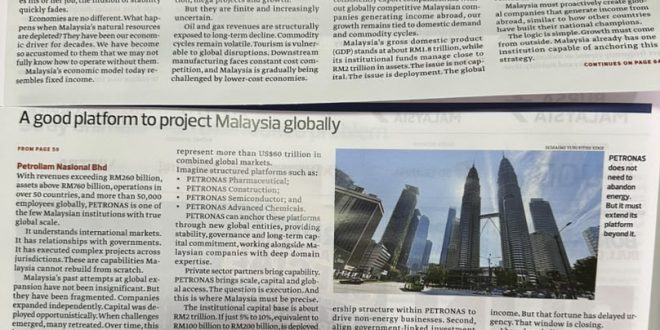
Petroliam Nasional Berhad (PETRONAS)
With revenues exceeding RM260 billion, assets above RM760 billion, operations in over 50 countries, and more than 50,000 employees globally, Petronas is one of the few Malaysian institutions with true global scale.
It understands international markets.
It has relationships with governments.
It has executed complex projects across jurisdictions.
These are capabilities Malaysia cannot rebuild from scratch.
Malaysia’s past attempts at global expansion have not been insignificant.
But they have been fragmented.
Companies expanded independently. Capital was deployed opportunistically. When challenges emerged, many retreated.
Over time, this has created hesitation.
Many boards today remain cautious about international expansion. The discussion often stops at the boardroom. Too many have tried and not succeeded.
So the question becomes.
How will this be different?
The answer lies in coordination.
Not in individual effort.
This is where Petronas becomes critical.
Not as a competitor.
But as a platform to project Malaysia globally.
This can be done through sector diversification into pharmaceuticals, construction, manufacturing, semiconductors and chemicals. Petronas does not need to abandon energy.
But it must extend its platform beyond it.
These sectors alone represent more than USD60 trillion in combined global markets.
Imagine structured platforms such as:
Petronas Pharmaceutical
Petronas Construction
Petronas Semiconductor
Petronas Advanced Chemicals
Petronas can anchor these platforms through new global entities, providing stability, governance and long-term capital commitment, working alongside Malaysian companies with deep domain expertise.
Private sector partners bring capability.
Petronas brings scale, capital and global access.
The question is execution.
And this is where Malaysia must be precise.
Malaysia’s institutional capital base is approximately RM2 trillion.
If just 5% to 10%, equivalent to RM100 billion to RM200 billion, is deployed into global acquisitions and platforms, and achieves a return of 8% to 12% annually:
Malaysia can generate RM8 billion to RM24 billion in external income every year.
This is new income.
Not domestic recycling.
Not dependent on natural resources.
In pharmaceuticals alone, capturing just 1% of the global market represents a USD15 billion opportunity.
In semiconductors, upstream participation could add USD5 billion to USD8 billion annually.
In construction, even a 0.5% share of the global market represents a USD70 billion opportunity.
These are not marginal gains.
They are transformational.
Execution must therefore be structured.
First, establish a dedicated leadership structure within Petronas to drive non energy businesses.
Second, align GLIC capital into coordinated co investment platforms.
Third, adopt a buy and build strategy through acquisitions and partnerships.
Fourth, ensure public private collaboration, not substitution.
Fifth, measure success through overseas revenue contribution to GDP.
Malaysia cannot remain a domestically driven economy and expect sustained growth.
At some point, growth must come from outside.
Either Malaysian companies expand outward or others will continue capturing global value while we remain dependent on what we already have.
Malaysia has been fortunate.
Our natural resources have provided decades of income.
But that fortune has delayed urgency.
That window is closing.
I have long believed Malaysia can produce global champions.
I have seen Malaysian talent lead at the highest levels when given the opportunity.
We have the ingredients.
What we need now is execution.
The question is no longer whether we can.
The question is whether we will act in time.
Because when our current model runs out, adjustment will no longer be strategic.
It will be forced.
And by then, the cost will be far greater.
We will not just slow down.
We risk being left behind.


